
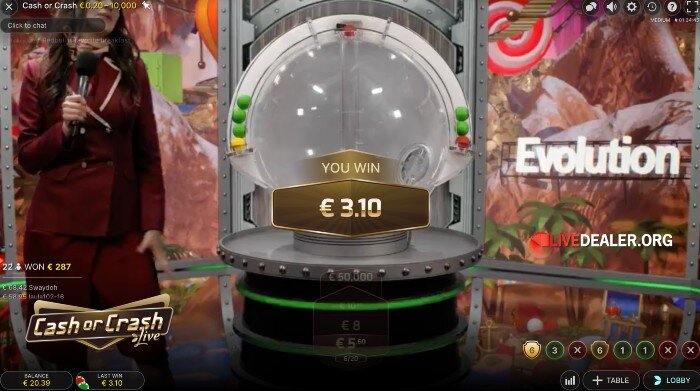
Cash Or Crash Live Online Slot creates its own niche in the realm of live game shows. Its charm is found in a potent mix of stage show and game rules that transforms every round into a test of your nerves. This is not just a spin of a roulette table. In this experience, you are in control, making active choices that influence your payout. The idea draws you in with a climbing multiplier, then dares you to grab it before a hidden “crash” wipes the slate clean. To fully benefit from the game, you need to look past the lights and grasp its real function. Let’s examine the stages, the host’s function, the mathematics of risk, and how players can practically navigate the thrills.
Finale: A Harmony of Chance and Selection

Cash or Crash Live is a captivating mix of sheer luck and deliberate choice. Its mechanics are designed to craft a story of rising risk, powered by a transparent RNG and animated by a charismatic host. Measuring victory as a fun and likely profitable game hinges on a few things. It’s less about predicting the uncertain and more about grasping how the game is built. It calls for controlling your funds with restraint and curbing the mental inclinations the game skillfully stimulates. By mastering its levels, respecting its mathematical foundation, and adhering to a custom strategy, you can change your experience. You transition from puzzled uncertainty to knowledgeable engagement in a exceptionally intense live game show.
The Primary Purpose and Core Mechanics
The goal of Cash or Crash Live is easy on the outside. You need to determine when to exit a increasing multiplier before a concealed “crash point” ends the round and takes your profits for that phase. All game commences with players making bets. A rocket then launches its ascent, and a multiplier commences climbing from 1x. The journey has several stages. Pre-launch, a unknown crash multiplier is determined for every stage, hidden from everyone. As the multiplier climbs, players individually decides to hit “Cash Out,” locking in that multiplier on their wager, or to continue. If the rocket reaches the hidden crash point prior to a player exits, they lose their bet for that round. The loop of hazard and profit occurs over multiple phases. Surviving players grow their earnings incrementally.
Deconstructing the Stage Structure
View the game as a collection of different sections, each a brand new risk. Avoiding a crash doesn’t remove you from the game. You proceed to the next stage with your built-up winnings safe, then start the risk process from scratch on the next leg of the rocket’s flight. This framework is paramount. It generates a narrative, with tension that builds as you go. The presenter heightens the excitement, revealing how many players are still riding the rocket as the multiplier reaches scary values. First rounds often involve cautious plays. Later stages, with their high-stakes multipliers, entice you to gamble the profit you’ve already banked. This segmentation is the heart of the game’s excitement. It demands a string of independent, critical decisions instead of a single one.
From Green to Red: The Increasing Danger
Observe the colored trajectory the rocket follows. It’s a core part of the game’s language. The initial section is usually a “Green Zone,” a safer phase where a crash is still possible. Next, the rocket might reach an “Amber Zone,” a clear warning that hazard is growing. The last segment is the “Red Zone.” Here, multipliers look their best, but the likelihood of a crash is mathematically at its peak. These colors are not just cosmetics. They give you a visual shorthand for the degree of risk at any moment. They transform an abstract probability become concrete. Knowing the game is deliberately informing you about growing risk is a critical piece of tactical knowledge.
Theoretical Underpinnings and Risk
Let’s examine the figures that make the game tick. The crash multiplier for each stage is derived from a set statistical distribution. Regular, low multipliers for instance 1.2x or 1.5x have a high chance of being selected. Very large multipliers can occur, but they are exponentially more rare. This system maintains the game fair. The regular, small crashes fund the occasional, large potential wins. The “Return to Player” (RTP) is a statistical percentage spanning millions of games. In your single session, the swings are wild. You’re not wagering against the house in a conventional sense. You are making decisions against a concealed, random value. Keep these key facts in mind:
- Independent Stages: Every round’s crash point is an independent occurrence. A crash of 1.2x in round one gives no info about round two.
- No Forecasting Ability: The RNG rules out any predictable sequences. Previous crashes or large wins do not affect future rounds.
- House Advantage: The game’s design includes a built-in house edge, which is shown in the publicly disclosed RTP from the provider.
Methodological Structures and User Behavior
No strategy can overcome the inherent randomness. But you can use disciplined approaches to control your funds and your emotions. The main conflict is a compromise. Do you secure assured gains, or pursue explosive profits? Users often employ techniques like the “Fixed Cash-Out.” With this approach, you determine ahead of time to cash out at a specific multiplier, say 2x, in every stage. This seeks stable, small gains. The contrary is the “Let It Ride” style, where you risk many phases for a shot at a monster payout, recognizing that losses will happen. A more strategic tactic is the “Percentage Bankroll” system, where you modify your wager amount based on your current winnings. The biggest factor, though, is in your mind. Can you resist the “greed factor” when the multiplier climbs? Can you avoid frustration after an premature loss? Your best weapon is creating firm guidelines for yourself before the game even starts.
Frequent Errors to Avoid
Watch out for a few common errors. The most harmful is “chasing” a loss. This signifies recklessly boosting your bet after a defeat, which violates the process’s round-independent nature. Another misstep is falling for the “hot hand” misconception, thinking a streak of large ratios is expected to persist. Letting the commentator’s talk or the behavior of other participants divert you from your own predetermined strategy is frequent. Also, avoid misinterpreting the sections. The Amber and Red Zones are not obstacles to beat. They are signals that the risk has jumped. Starting any round without a clear goal converts the session from a session of decisions into a sheer emotional ride. That journey seldom finishes well.
The purpose of the live host and RNG
The presenter goes beyond talk. They establish the game’s emotional pace. While they can’t affect the result, they expertly build suspense. They call out the climbing multiplier and offer live updates on what percentage of the crowd is cashing out at each level. That social cue can affect your head. But remember, the host works separately from the game’s engine: the Random Number Generator (RNG). The crash point for each stage is set by a certified RNG the instant the stage begins. This ensures fairness and total unpredictability. The host has no clue when the crash will happen. Their job is entertainment. The RNG’s job is certifiable fairness. This combination combines transparent live action with provably random results.
